Home > History Hub > Bessy Flower
Bessy Flower (1851-1895)
A young Menang girl, topped Albany’s Annesfield School, earning a certificate of proficiency and an invitation to study in Sydney.
By: Tanya McColgan | 21 Jun 2024
In the mid-nineteenth century, a young Menang girl whose life would span country, colonies and communities, left a quiet, yet enduring mark on the history of Western and eastern Australia. Raised within one of the earliest Aboriginal schools in the region, Bessy grew from a “bright-eyed” child into an accomplished student, musician and teacher whose abilities were recognised far beyond her place of birth. Her journey from Albany to Sydney and onward to Victoria reflects a life shaped by learning, movement and contribution.
Elizabeth “Bessy” Flower, also known by her birth name Quinnupp, was born in 1851, the daughter of John Bunger and Mary Flower. It is understood that her father John, was employed as a servant to Henry Camfield.
It is possible that Bessy’s given name Elizabeth, was assigned by the Camfields, perhaps after one of Henry Camfield’s sisters. Across the historical record, her name appears in several forms; Bessy, Bessie and Betsy, reflecting the different contexts in which her life was recorded over time. The earliest known reference, recorded in the late 1850s in M. McKay’s account of the Natives’ Institution at King George’s Sound, identifies her as “Bessy,” describing her as a “bright-eyed, intelligent” child.
By the 1860s, contemporary newspaper accounts refer to her as “Elizabeth” or “Betsy,” particularly in relation to her journey to Victoria in 1867. Later retellings alternate between Bessy and Bessie, while Nyungar Tradition: Glimpses of Aborigines of South-Western Australia 1829–1914 returns to the form Betsy. These variations reflect not confusion, but the passage of time and the different voices through which her life has been recorded.
Bessy’s early life was closely tied to the beginnings of the Annesfield school, located on Serpentine Road, an institution established in 1852 by Anne Camfield, supported by her husband Henry and encouraged by Archdeacon Wollaston. The school, initially conducted within the Camfields home and later in a purpose-built building nearby, became one of the earliest centres of education for Aborignal children. The Camfields, who had no children of their own, took several Aboriginal children into their care and raised them as part of their family, providing not only teaching but a structured domestic environment in which the children lived, learned and developed.
In 1852, Bessy’s older sister, Kojonupat, later baptised Matilda, was the first child taken into the Camfields’ care. Though her life was short, her significance is enduring. Matilda’s life represents the starting point of a generation of children who would receive education and be raised within a nurturing environment. Bessy and her younger siblings, Ada and Henry followed soon after, forming part of this first group of children whose lives became closely intertwined with Henry and Anne Camfield.
Bessy herself entered the Camfields care at a very young age. A visitor in 1858 described Bessy as a “bright-eyed” and intelligent, girl already showing a strong desire to learn and a determination to match the efforts of the older girls.

Bessy Flower at Annesfield School, c.1860.

Bessy Flower with Anne Camfield at Annesfield School, c.1860.
This early description is reinforced by later recollections of her character. She was known to be affectionate and gentle, forming a close bond with Mrs Camfield, whom she called “Missie,” a term of familiarity and warmth that she continued to use throughout her life. At the same time, there are indications that she retained a connection with her natural mother, suggesting that her life bridged both her Minang/Menang heritage and her upbringing within the Camfield household.
Life at Annesfield was structured but active. By the late 1850s, the household included a small community of children who were taught reading, writing and arithmetic, while the older girls were trained in domestic work such as sewing, washing and cooking. Within this environment, Bessy quickly stood out. She showed both aptitude and enthusiasm, participating fully in lessons and daily routines. Even as a young child, she demonstrated skill with needlework and a readiness to engage in all aspects of learning. Her intellectual curiosity was particularly notable. Later in life, Henry Camfield would recall that she was rarely without a book, developing an early and lasting interest in reading.
In 1864, at the age of 13, Bessy was awarded a Certificate of pPoficiency, and Bishop Hale, who had taken a particular interest in the Camfield School and its students, arranged for Bessy to attend a Church of England Model School in Sydney. She travelled by sea to attend the school, and this journey marked a major step in her life, placing her within a much broader educational network. In Sydney, she studied English, history, geography and arithmetic, along with music and the arts. Her musical ability, already evident in Albany, was further refined, and she became proficient enough to play the organ at St Phillip’s Church. During her time there, Bessy also learned to play chess, becoming so skilled that in later years she reported defeating a Victorian chess champion.
Her experiences in Sydney expanded her world considerably. Later accounts would refer to her as having travelled across the colonies, reflecting the opportunities she had embraced at a young age. On returning to Albany in 1866, she took on a new role alongside Anne Camfield as her assistant, continuing her work as a teacher and serving as organist at St John’s Church in York Street. Her musical reputation was widely recognised, and visitors to Albany often sought opportunities to hear her play, frequently including a visit to Camfield. Her position within the community was one of respect and recognition.
Bessy’s relationship with the Camfields remained close. Having been raised from early childhood within their household, her letters suggest a deep and genuine affection for her adoptive parents. She continued to refer to them as “Missie” and “Martie,” the familiar names she had used since childhood, and her later correspondence reflects an enduring sense of connection. At the same time, her life was shaped by expectations that extended beyond Albany.
In 1867, Bessy undertook another significant journey, travelling from Albany to Melbourne with her sister Ada and three other young women from Annesfield—Norah, Rhoda, and Emily. Sadly, Ada died soon after arriving in Victoria. This movement formed part of a broader pattern linking institutions in Western Australia with mission stations in Victoria. While some of the women were intended to marry Christian Aboriginal men, Bessy’s role was distinct; she travelled to take up a position as a teacher at the Ramahyuck Mission.
Her arrival in Victoria was recorded in contemporary newspapers, providing a rare public account of her at the time. The Launceston Examiner reported that among the passengers were several Aboriginal women from Western Australia, naming “Elizabeth” among them and describing her as “an accomplished and highly educated person.” A similar account appeared in the Perth Gazette and West Australian Times, reinforcing both her identity and her reputation.
At Ramahyuck Mission in Gippsland, under the supervision of Reverend Friedrich Hagenauer, Bessy began her work as a teacher. She taught both Aboriginal children and those of nearby settlers, and her effectiveness as an educator quickly became evident. Her students achieved strong results, and she played a central role in the intellectual life of the mission. Her musical contributions also continued, as she served as organist and contributed to the religious and cultural life of the community.
Soon after her arrival, Bessy attracted the attention of a white labourer who proposed marriage. Reverend Hagenauer, uneasy with the prospect of such a union, arranged for her to be sent to another mission for a period, returning only once the situation had settled.
Around this time, Donald Cameron, a Wotjobaluk man of mixed descent, was brought to Ramahyuck from another mission in north-western Victoria and was regarded as a more suitable partner. Although not as formally educated as Bessy, he was capable and well regarded. Bessy accepted his proposal, despite also receiving a marriage proposal from a man in Albany supported by Henry Camfield.
On 4 November 1868, at the age of seventeen, she married Donald Cameron in a ceremony that combined Presbyterian and Indigenous customs. Following her marriage, her role at the mission changed. When the original teacher returned, Bessy’s responsibilities shifted to those of housemother and religious instructor, taking on more domestic and supervisory duties. About a year later, she became a mother, her first child born soon after. Her children included Annie Magdalene (Maggie), Nellie Grace, Louisa Alice, Donald Boyd, Haines Adolphus, Ada May, Mena Blanche, and Keith Flowers.
Several did not survive to adulthood, and her family life was marked by significant loss. It is understood that Bessy lost three of her children during her lifetime, including her son Boyd, who died in infancy, and her daughter Ada, who died at the age of twenty-one.
Despite these changes, Bessy’s life endured. She remained an avid reader, and her letters reveal a thoughtful and articulate woman who supported her family, communicated with authorities and advocated on behalf of others.
Over time, however, her life became increasingly shaped by the restrictions of mission life. Her letters suggest she had expected her stay to be temporary, hoping to return to Albany, but by 1871 this was no longer possible. The Camfield's had closed their school, Henry died the following year and Anne relocated to Perth.
Her love of reading, once praised, came to be criticised. A visiting clergyman described her as “a constant reader,” but later remarked that it “would be better… if she looked to her house more and read less.”
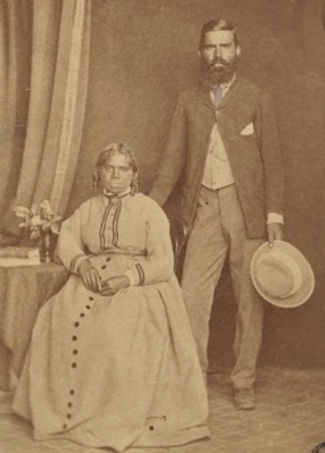
Elizabeth ‘Bessy’ Cameron nee Flower with her husband Donald Cameron of Victoria, c. 1868. [State Library of New South Wales.]
By 1878, her life was marked by further hardship when Donald formed a relationship with another woman. The strain this caused led Bessy to consider leaving, but she was prevented from taking her children, forcing her to remain. Over the following decade, the family moved between missions and at times lived outside mission control, seeking stability. These years were difficult, marked by hardship and uncertainty, yet they also reflect Bessy’s resilience and adaptability.
In 1886, new legislation forced Donald to leave the mission. Bessy followed him into the wider community, where they faced racism, unemployment and the forced indenture of two of their daughters. Eventually, she returned to the mission alone and used her literacy to advocate for her family and others, writing to authorities and newspapers. This brought her into conflict with officials, who regarded her as troublesome. These continuing pressures took a significant emotional and physical toll on Bessy.
On 14 January 1895, at the age of 44, Bessy died of peritonitis and was buried in the Presbyterian section of Bairnsdale Cemetery in East Gippsland, Victoria in an unmarked grave. She was laid to rest next to her nine-year-old daughter. Bessy was survived by five children, three daughters and two sons although her daughter Louise died the following year. Donald Cameron appears to have still been alive in 1910.
Bessy never returned to her Minang homeland. She was an exceptionally gifted woman, remembered for her intelligence and warmth—an accomplished student, teacher, musician, writer, and mother. Her life connected Albany, Sydney and Gippsland, and her story continues through her descendants, who carry forward her memory.