
Our Past . Our Story . Our Albany

History Hub
The history we share as a society, helps create an opportunity to connect to the past to celebrate the present.
Explore the rich and diverse history of Western Australia's first settlement with Albany Historical Society.
The Albany History Hub is your online gateway to exploring the rich and diverse history of Albany/Kinjarling. More than just a digital archive, it is a living, evolving space dedicated to preserving, celebrating and sharing the stories, people and events that have shaped our region’s unique identity.
Here, visitors can delve into detailed historical accounts, view rare photographs and documents and discover personal stories that bring Albany’s past to life. From the early Menang, custodians of this land to the settlers who helped build the town, the History Hub connects the threads of our shared heritage.
Through engaging, informative and carefully curated content, it seeks to inspire curiosity, foster respect for cultural diversity and cultivate a deeper understanding of the forces that continue to shape our community. The History Hub ensures that Albany’s historical legacy remains alive, accessible and valued—today and for generations to come.

A Whadjuk Noongar leader from the Swan River region, he defended the survival, dignity and rights of his people, seeking fairness and coexistence.

For a man who held a highly responsible position of authority and had a successful military career spanning twenty-five years, there is scant recognition of Captain

James Dunn was better known as a wheelwright, pastoralist and builder. He was contracted with John McKail to build the first Albany Jetty and was also appointed Gaoler and Police Constable.
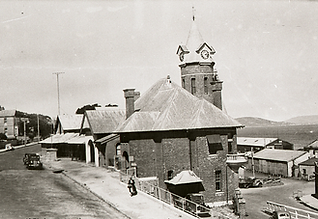
In 1963, Postmaster, Mr. Wally Offer presented a comprehensive and captivating account to the Albany Historical Society of the long and rich...

An enlightening journey into the remarkable story of Tommy King and the Menang people and their diplomacy, loyalty and deep cultural pride.

One might refer to John McKail as a ‘rebel with a cause’, a colourful character, who traversed the Swan River Colony with his fiery nature, acts of insurrection and irascible nature. Relocating to Albany altered McKail into a man of his word.

Sydney, November 1826. The newspapers eagerly reported the departure of an Expedition to King George’s Sound including many details.

A visionary vanguard, who with the assistance of his officers, convicts and the Menang people, laid the foundation for the first settlement in Western Australia.

At just 13 years old, Bessy Flower, a young Menang girl, distinguished herself as the top student at the Camfield School in Albany, she displayed her exceptional academic performance that earned her a Certificate of Proficiency.
LOCAL HISTORY
Albany Classic History
Ninety Years of Speed, Spirit and Community.
For ninety years, the streets of Albany have carried the memory of roaring engines, daring drivers and one of the most remarkable chapters in Western Australian motorsport history.
What began as an ambitious Easter race meeting in 1936 quickly evolved into a tradition that captured the imagination of thousands and established Albany as the home of “Round the Houses” racing in Western Australia. Yet the story of the Albany Classic is about far more than motor racing alone, it is a story of community spirit, local pride and a town that embraced the excitement and spectacle of a new era.


Sally Pell brings the story of the Albany Woollen Mills back to life in Connecting Threads — celebrating the industry that became the backbone of Albany.

The US President, Herbert Hoover passed through Albany in 1897, quarantined at Quaranup and later stayed at the Albany Hotel.

Albany’s busy early-1900s port inspired artists Claude and Victor Batelier, who captured its ships and shifting horizons in delicate watercolours and sketches.

Patrick Taylor was a leading figure in the town's affairs for several years. A fanatically religious man, he was deeply concerned with the death of clergymen in the new colony.

Read the fascinating history of the home of the first and early settlers and the contribution that shaped the foundation of Albany but the history of the State of Western Australia.

Major Eric Samuel Everett’s life combined distinguished wartime service with lasting contributions to business, community and veteran organisations, reflecting courage, leadership and dedication.

Jack Schumann was a larger than life figure in Albany from the late 1800s into the 1900s. A pioneering diver, intrepid sailor and all round adventurer.

Perched on Mt Clarence, the Avenue of Honour and Desert Mounted Corps Memorial honour courage, sacrifice and our connection to Australia’s military history.

Two of Australia’s most iconic literary voices, Henry Lawson and A.B. “Banjo” Paterson, captured the spirit, struggles, and stories of a young Australia.

John McGovern, Head Warder of the Albany Convict Gaol from 1879 to 1913. McGovern was a Police Constable at York in 1870-1871 before he was transferred to Perth and then Fremantle.

On December, 5th 1931, Norman House (then Edwards House) became the first Toc H Mark I in Australia. There were 28 Marks in the world, the first in the Commonwealth was by way of gift from Miss Dymes.

The most infamous Australian serial killer was captured in the goldfields’ town of Southern Cross, Western Australia. When Deemings was transfer back to Melbourne, he spent a night at the Albany Convict Gaol.

The meticulous historian whose research, advocacy and civic leadership laid the foundations for preserving Albany’s built heritage.

Chinese migrants, often overlooked in early Australian history, played a vital role as pioneers whose hard work helped shape communities like Albany.

Major Doctor Ingoldby had been severely wounded at the notorious Battle of Koster River in the western Transvaal, South Africa on 21-23rd July 1900.

Sir Richard Spencer, Lady Anne and their nine children and eleven servants arrived at King George Sound on 13 September 1833. Sir Richard was newly appointed as Government Resident at Albany.

In 1867, Peninsular and Oriental Steam Navigation Company agent, William Clifton encouraged his large staff to form a Co-op Society, later to carry out its business at the corner of Fredrick and Spencer Street.

TRUE CRIME
The Great Escapes From the Albany Convict Gaol
When desperate inmates and poor planning turned escape attempts into unforgettable failures.
Built in 1852 and intended as a formidable barrier between inmates and freedom, the Albany Convict Gaol was designed to be escape-proof. Yet throughout its chequered history, prisoners repeatedly tested its stone walls, steel doors, and vigilant guards — often with more enthusiasm than success. Rather than daring feats of criminal ingenuity, many escape attempts were undone by poor planning, bad luck, or sheer misjudgement, resulting in breakouts that were frequently more farcical than fearless. Behind the gaol’s imposing walls lies a collection of escape stories that are as eyebrow-raising as they are unintentionally amusing.