
Home / History Hub / Herbert Hoover in Albany
Herbert Hoover in Albany: Quarantine, Gold, and a Future President
From Quarantine Station to World Stage: Herbert Hoover’s Early Journey Through Albany and Western Australia.
By Tanya McColgan | 22 Jan 2026

Herbert Hoover photographed in Perth in 1898. Source: State Library of Western Australia.
Long before Herbert Clark Hoover (1874–1964) became the 31st President of the United States, he passed quietly through Albany, leaving behind a little known yet remarkable chapter in the town’s history. At the close of the nineteenth century, Albany was Western Australia’s principal deep-water port and a vital gateway to the colony, linking the remote goldfields with the wider world.
In 1897, the town became the unlikely starting point of Hoover’s Western Australian experience, an experience that would help shape both the state’s gold mining industry and decades later, influence global politics through the rise of one of the twentieth century’s most prominent leaders.
Herbert Hoover arrived in Albany on 13 May 1897 aboard the P&O steamer R.M.S. Victoria. He was just 22 years old, a recent graduate of Stanford University, and newly employed as a mining engineer by the British firm Bewick, Moreing & Co. Like many young professionals drawn to Western Australia during the gold rush era, Hoover came seeking opportunity on the rapidly expanding goldfields.
His intention was to disembark at Albany and travel inland to the goldfields of Coolgardie, where demand for skilled engineers was high and fortunes, both personal and corporate were being made.
However, Hoover’s arrival in Albany did not proceed as planned. The Victoria put into port under unfortunate circumstances, disrupting the onward journey of all on board. As reported by The Advertiser on Monday, 17 May 1897, under the heading “Quarantine Arrangements”, the newspaper stated:
“The R.M.S. Victoria arrived yesterday in quarantine, having touched at an infected port; but there is no sign of disease on board. The Australian colonies consider it necessary to adopt the utmost precautions, and there is no doubt that in their circumstances these are amply justified.”
Although no illness had yet manifested, the vessel was considered a potential carrier of smallpox. As a precautionary measure, all passengers were placed into quarantine at Quaranup, where the quarantine station’s original buildings were already established.
Among the quarantined passengers was a young mining engineer listed simply as “Herbert Hoover.” After spending a quiet week in isolation, Hoover was released and allowed to continue his journey inland. At the time, few in Albany realised the significance of this unassuming passenger. Had the “Albanians” known who he would later become, it was said they would have made much of him.

Quaranup Quarantine Station, 1908 (Albany Historical Society, P97.855)
Following his release from quarantine, Hoover travelled to the goldfields, where he quickly developed a reputation as one of the colony’s most capable and controversial mining engineers. Working for Bewick, Moreing & Co, he played a pivotal role in advising the firm to purchase the Sons of Gwalia mine near Leonora. The mine would go on to become one of the most profitable and long-lived gold operations in Western Australia, only closing in 1963.
Herbert Hoover was appointed the first official manager of the Sons of Gwalia mine on 1 May 1898, at just 22 years of age. His management style was uncompromising. He introduced sweeping cost cutting reforms, lengthened working hours, eliminated bonuses, altered shift-change procedures and clashed openly with the Miners’ Union.
He also employed migrant contract labour, particularly Italian workers, whom he regarded as allies against union power. These policies sparked significant conflict at the time but had long lasting consequences. The strong migrant workforce Hoover helped establish gave Gwalia its distinctive cultural character well into the twentieth century.
During his short tenure from May to November 1898, Hoover also designed the mine manager’s house and oversaw plans for staff and office buildings overlooking the mine and township, leaving a physical as well as an economic legacy.

The Sons of Gwalia mine near Leonora, 1901 (State Library of Western Australia, 000703D)
Hoover’s connection with Albany did not end with his arrival in 1897. He returned to the town several times during his Western Australian years, most notably prior to his departure overseas. A report in the Menzies Miner dated 3 December 1898 records that Mr H. C. Hoover left Menzies by train for Kalgoorlie, then Perth, before departing Albany on 10 January 1899 for Europe and subsequently China. He had been appointed attorney for Bewick, Moreing & Co in China, where he would supervise the firm’s extensive mining interests.
During one of these later visits, most likely in late 1898 or early 1899, Hoover stayed at the Albany Hotel on York Street. By the late 1890s, the Albany Hotel was one of the town’s most prominent accommodation houses, ideally situated near the harbour and railway terminal. It regularly hosted mining engineers, government officials, shipping agents, and businessmen travelling enroute to and from the goldfields. Given Hoover’s senior role with Bewick, Moreing & Co and his frequent long distance travel, the Albany Hotel would have been a logical and respectable choice of lodging.
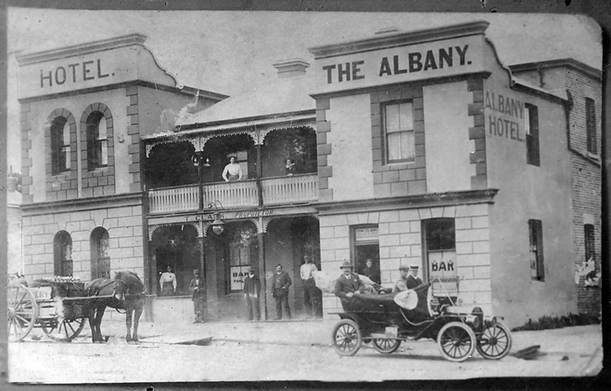
Albany Hotel on York Street, c1910 (Albany Historical Society, P98.167)
Physical evidence of Hoover’s stay survives in the Albany Hotel guest book, which contains his signature. This record places Hoover firmly within the social fabric of Albany at the turn of the twentieth century and confirms that he was more than a transient arrival in quarantine, he was a returning visitor who engaged with the town in a conventional and recognisable way. Alongside his signature, Hoover added a brief but memorable remark: “Not dead, but sleeping.”
This entry has been widely noted and is often interpreted as a reflection of Hoover’s dry humour and understated personality. By this time, he was already known in mining circles for his sharp intellect, efficiency, and intolerance for waste, traits that would later define both his management style and political career.
After leaving Western Australia, Hoover went on to China as chief engineer for the Chinese Bureau of Mines and general manager of the Chinese Engineering and Mining Corporation. Despite his global career, he retained confidence in Western Australia’s mining potential, writing in 1899 that the state was “a country of surprises” with significant future prospects. In 1901, Hoover became a partner in Bewick, Moreing & Co, overseeing major mining investments, including those in Australia. His later career would see him become an international humanitarian, Secretary of Commerce, and ultimately President of the United States from 1929 to 1933.
President Herbert Hoover died on 20 October 1964 at the age of 90. Yet in Albany, his legacy endures in the quarantine station across the harbour, in the guest book of the Albany Hotel on York Street and in the quiet knowledge that a future world leader once waited out the threat of smallpox on the shores of King George Sound before heading inland to make his mark on Western Australia